
BANSKA WYZNA
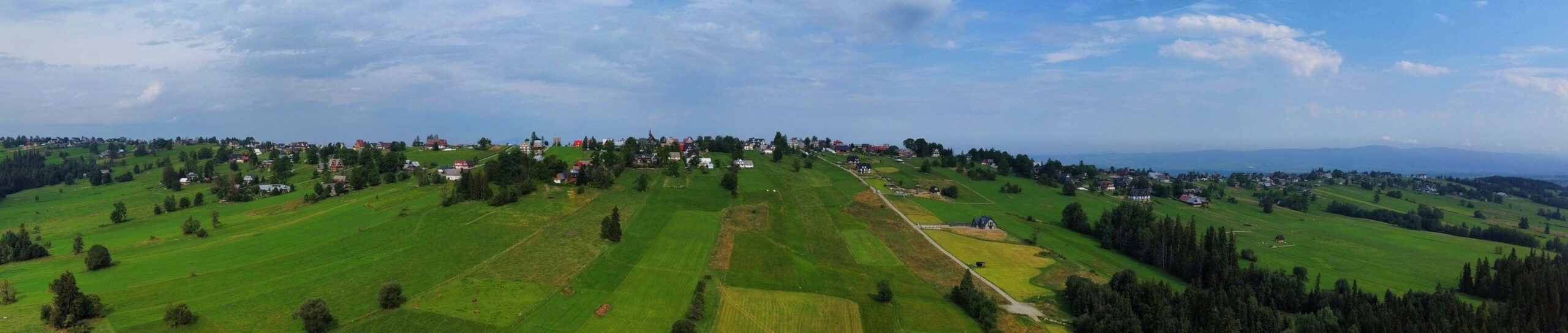
Banska Wyzna (formerly Banska Gorna, originally Banska) is a Podhale village in the Szaflary commune, Nowy Targ County, Lesser Poland Voivodeship (postal code 34-424). It lies on the Gubałówka Foothills, on the northern ridge of Gubałówka, at an elevation of approximately 740–907 m a.s.l., with its highest point, Świerków Wierch, at about 907 m a.s.l. It is one of the highest situated settlements in Poland, offering a wide panorama of the Tatra Mountains, the Gorce Mountains, Babia Góra, the Nowy Targ Basin and the Orava region. It borders Bańska Niżna, Biały Dunajec, Leszczyny, Sierockie, Skrzypne, Czerwienne and Maruszyna. The distance to the center of Nowy Targ is about 12 km, and to Zakopane about 15 km..
The village has a linear layout – its buildings stretch along the ridge and ridge roads, typical of settlements in the Gubałówka Foothills. Bańska Wyżna consists of the hamlets of Bustryczany, Gielatówka, Kubaczówka and Pitoniówka, as well as streets such as Szlak Papieski, Do Cieślów, and the Gielatówka, Kubaczówka and Pitoniówka residential areas. Several streams flow through Bańska – Krajowy, Florynów, Pitoniowski and Mościska – draining into the Biały Dunajec, then into the Dunajec, the Vistula and the Baltic Sea. The terrain is relatively fertile for this altitude, dominated by meadows, pastures and fields located on former forest clearings.
The earliest traces and beginnings of settlement
Although no archaeological research has been carried out specifically in Bańska, traces of settlement from the Late Neolithic and Early Bronze Age have been recorded in the nearby area (Szaflary, Biały Dunajec, surroundings of Nowy Targ). This indicates that the ridges on which present-day Bańska lies may have been used seasonally (hunting, grazing), although there is no evidence of a permanent settlement before the Middle Ages.
From the Middle Ages onward, Podhale was colonized along two paths: by Polish knights and monastic estates, and by Vlach shepherds, who introduced a high-mountain pastoral economy based on the transhumance of sheep. Bańska fits this pattern – permanent settlement on the ridge gradually developed from shepherds’ clearings and mountain pastures.
The founding of the village and the etymology of the name
The beginnings of Bańska are closely tied to the colonization of royal lands within the Nowy Targ starosty. The starting point is considered to be the royal privilege of 1532 issued by Sigismund I the Old, which opened the way for settlement “on raw root” in the forests above the Biały Dunajec. In 1580, the first known mention of the settlement appears under the name “Banyjska”. In 1591, Andrzej Prokop Pieniążek, the Szaflary leaseholder, carried out the formal foundation of Bańska under German (Magdeburg) law, granting the sołtys farmsteads and establishing the peasants’ obligations.
The first known village head (vogt) was Jędrzej Jarząbek, active during the reign of Sigismund III Vasa. He served as a judge, collected dues and maintained order, benefiting from the so-called “third penny” from court fines. Tradition also associates him with an expedition to the king to obtain the “cyrkiel” – a document marking the boundaries of the Żywczańskie clearing in the Tatra Mountains, which demonstrates the involvement of Bańska’s inhabitants in disputes over Tatra pastures.
The name “Bańska” has several competing explanations. The most common interpretation links it to the road leading to former metal ore mines in the Tatra Mountains – the so-called “bań” or “banisk” – therefore the name would have meant a village located on the road “to the mines”. A second hypothesis connects the name with the term “Brzóska Mała” / “Brzyska Mała”, referring to the area of today’s Bańska Niżna, specifically the Brzyzek (Podbrzyskami) hamlet. There are also loose suggestions of a Hungarian origin of the name, but they lack solid source evidence.
Bańska in the Polish–Lithuanian Commonwealth
In the pre-partition era Bańska was a royal village within the Szaflary estate of the Nowy Targ starosty. Its economy relied on high-mountain agriculture (rye, oats, later potatoes) and sheep and cattle herding. The inhabitants held grazing rights on Tatra pastures, including Hala Upłaz, and conflicts over pasture boundaries with starosts and neighbouring villages were a recurring feature of local history.
The social structure was typical: fullholding peasants, smallholders, cottagers and servants. Small crafts developed (carpentry, cooperage, blacksmithing, processing of sheep’s wool), mainly for local needs and for the surrounding villages. The absence of metal deposits in the area makes any link between the village’s name and local mining highly unlikely – the key mines were in the Tatra Mountains, and the routes leading to them passed through Bańska.
Partitions, Galicia and the Uznański estate
In 1770, even before the First Partition, the lands of the Nowy Targ starosty, including Bańska, were seized by Austria as part of the so-called sanitary cordon, and in 1772 they formally became part of the Kingdom of Galicia and Lodomeria. The village became a Galician settlement in Nowy Targ County, subject to Austrian law and district administration.
In 1818–1819 the Szaflary estate, including Bańska, Biały Dunajec, Gliczarów, Murzasichle, Poronin, Skrzypne, Szaflary and Zaskale, passed into the hands of the Uznański family of the Jastrzębiec coat of arms, specifically Tomasz and Honorata Uznański. In practice this meant a shift from direct royal starost authority to the control of a private landowner. The Uznański family derived income from forests, mountain pastures, the alcohol monopoly and rents, while also maintaining a presence in Tatra affairs (notably Adam Uznański in the Tatra Society).
The 19th century was a period of overpopulation, poverty and heavy tax burdens for Bańska. Some inhabitants took part in independence movements (including the events of 1846), while many emigrated for work to cities and to the United States. Money sent back from emigrants made it possible to build the first brick houses at the turn of the 19th and 20th centuries. The development of the railway (the Kraków–Zakopane line via Szaflary, completed in 1899) improved transport throughout the region, indirectly benefiting Bańska as well.
During this period the division into Bańska Górna and Bańska Dolna took shape. As more highly situated fields and clearings were settled, the village became spatially “layered”; the lower part grew more closely connected with Szaflary, while the upper part – today’s Bańska Wyżna – retained a more pastoral and conservative character.
World War I and the Second Polish Republic
During World War I the inhabitants of Bańska, as Austrian subjects, were drafted into the imperial–royal army, while some – in line with Podhale’s independence traditions – joined the Polish Legions. Among them was Wojciech Sieczka, a soldier of Józef Piłsudski’s Legions, and a commemorative cross on Sieczkowe Hill was erected in his honour. After 1918 the village became part of the reborn Polish state (Kraków Voivodeship). The Uznański estate gradually lost its importance and was parcelled out; more and more farms became the property of the peasants themselves, although still heavily fragmented.
In 1907 a school was opened in the village, which significantly accelerated the spread of education and the elimination of illiteracy. In 1938 the parish of Biały Dunajec was established, and Bańska (both Niżna and Wyżna) was incorporated into it.
World War II
In September 1939 Podhale was occupied by the Slovak Field Army “Bernolák”, and Bańska itself fell under German occupation within the General Government. The inhabitants were affected by requisitions, mandatory quotas and deportations for forced labour in the Reich.
The region was subjected to the “Goralenvolk” operation, in which the German occupation authorities attempted to create from the Highlanders a supposedly distinct “Goral nationality” sympathetic to the Third Reich. In their justification the Germans referred, among other things, to the claim that the Highlanders had origins similar to their own, deriving alleged links with the Celts. As an argument they cited, for example, motifs found in traditional ornaments – especially in goral clasps. However, in Bańska, as in the whole Podhale region, loyalty to Poland prevailed, and collaborationist activity was met with distance. The village served as a support base for partisan units operating in the Gorce and Tatra Mountains.
Communist-era Poland – electrification, division of the village and geothermal energy
After the war Bańska became part of Kraków Voivodeship, Nowy Targ County and the Szaflary commune. The agrarian reform formally nationalised large estates, but in the village itself small peasant farms predominated, so the change was mainly formal. The 1950s and 1960s brought electrification, the expansion of the road network and the gradual mechanisation of agriculture.
During the communist era the administrative division was also regularised: the former Bańska was formally split into Bańska Niżna and Bańska Wyżna as two separate villages and sołectwos. Traditional sheep herding gradually gave way to dairy cattle farming and wage labour outside agriculture.
The 1980s also marked the beginning of the “geothermal revolution”: exploratory drilling was carried out in the Bańska area (including the Bańska IG-1 well), revealing some of the most abundant thermal waters in Poland. Based on these resources, geothermal heating plants and thermal pools were developed in nearby localities, which after 1989 significantly accelerated the growth of tourism in Bańska Wyżna.
Transformation after 1989 and the contemporary period
After 1989 the village’s economy underwent the classic Podhale transformation: agriculture and shepherding ceased to be the sole pillars of livelihood. Construction, transport, services, tourism and room rentals began to play an increasingly important role. The village became a “cheaper” alternative to Zakopane, Bukowina Tatrzańska and Białka Tatrzańska.
According to the 2021 National Census, Bańska Wyżna has 1,145 inhabitants, including 583 women and 562 men. Approximately 60% of the population is of working age, 25% is below working age and 15% is above working age. Since the late 1990s the village has recorded a clear increase in population, also due to the influx of people from outside the region attracted by its landscape qualities
Parish, church and public institutions
Historically, Bańska first belonged to one of the oldest Podhale parishes in Ludźmierz, later to the Szaflary parish, and from 1938 onward to the parish of Biały Dunajec. The independent parish in Bańska Wyżna, dedicated to Our Lady of Fatima, was established on 3 December 2006 by a decree of Cardinal Stanisław Dziwisz. The church, built between 1986 and 1995, features a distinctive interior designed by Władysław and Krzysztof Trebunia-Tutka; the sanctuary also contains the cross before which John Paul II prayed in 1997.
The village hosts a primary school, a volunteer fire brigade, the Highlanders’ Association and the regional ensemble “Watra”. In 2025 the Rural Housewives’ and Householders’ Circle of Bańska Wyżna was established, supporting, among other activities, local cheese production and the organisation of cultural events.
Social structure, families and everyday life
Traditionally, the community of Bańska consisted almost entirely of the peasant–highlander population: owners of small farms, smallholders, cottagers and seasonal labourers. The most notable historical family are the Jarząbek clan (including the vogt Jędrzej Jarząbek), but many local families have been rooted in the village for generations.
Currently the occupational structure is diversified: farmers, livestock breeders, tourism entrepreneurs, construction workers, service employees and public-sector workers. Many residents commute to work in Nowy Targ and Zakopane or travel seasonally to EU countries.
Economy, agriculture, geothermal energy and tourism
Until the mid-20th century the economy of Bańska was based on agriculture and pastoralism: the cultivation of oats, rye, potatoes and cabbage, the breeding of sheep and cattle, and the production of cheeses (oscypek, gołka, redykołka, bundz, korbace). Communal grazing on the pastures and meadows of the Szaflary estate shaped the village’s cultural landscape.
Today agriculture often has an “agritourism” character, and cheese production has become part of the tourist offer. The development of geothermal facilities in neighbouring localities (Szaflary, Bańska Niżna, Chochołów) has created additional jobs and attracted visitors who willingly choose accommodation in Bańska Wyżna. The village serves as a convenient base for thermal pools and nearby ski stations (Suche, Białka Tatrzańska, Bukowina Tatrzańska, Gliczarów Górny and others).
Folklore, dialect and heritage
The inhabitants of Bańska, known as Bańscans (Górnobańscany, Wyźniobańscany), are part of the Highlander community of Podhale. The Podhale dialect is heard in everyday speech, particularly rich in pastoral vocabulary of Vlach origin. Traditional Highlander dress, music, dance and multipart singing remain vibrant, especially within the activities of the “Watra” ensemble, the Highlanders’ Association and during church and family celebrations.
Bańska Wyżna is also known for its regional cheeses: oscypek, gazda cheese (various forms of gołka), redykołki, korbace and bundz. Wayside crosses and chapels have been preserved in the landscape, including the 19th-century Loretan bell tower (“burzówka”) opposite the church and the stone cross on Cieślowy. Part of the old wooden Podhale-style architecture still forms the village’s characteristic scenery.
Other sites
The village features numerous guest accommodations and restaurants (which we recommend), reflecting its tourist-oriented character. At present there are four grocery and general-merchandise shops operating in Bańska Wyżna.
In the vicinity of Bańska Wyżna there are numerous attractions, such as thermal pools and ski lifts, whose amenities can also be enjoyed in the summer season, as many offer scenic gondola rides.
Archival maps
Galicia and Lodomeria (1779–1783) – The first military review
Hungary (1819–1869) – Second military review of the Habsburg Empire
Galicia and Bukovina (1861–1864) – Second military review of the Habsburg Empire
The Habsburg Empire (1869-1887) – Third Military Review